
Clearwater County Arrest Warrants Explained
A Clearwater County arrest warrant is a judge's permission to take someone into custody on a specific charge. It grows out of a complaint and the sworn facts behind it. When those materials show probable cause, the court may issue the warrant, though Minnesota's rules prefer a summons unless the rule's circumstances call for more. Either way, the case moves to a court appearance. The charge, the conditions, and what follows all get decided there.
Who Signs a Clearwater County Arrest Warrant
Two roles, never one. In Clearwater County a district court judge signs the arrest warrant and sets its conditions; an authorized officer then executes it anywhere in Minnesota unless the warrant limits where service may happen. The officer need not carry the paper. He or she must tell the person the warrant exists and what the charge is, then certify that it was executed. That last detail surprises people who expect a document at the door. The paperwork follows the action, not the other way around. Note: the Clearwater County sheriff's office does not issue warrants and cannot change one, and the court does not serve them.
Inside a Clearwater County Arrest Warrant
A Clearwater County warrant is short by design. It names the person or describes them, states the offense, and lists any release conditions a judge attached. The complaint and the case file hold the rest of the story.
| Person | A name, or a description when the name is not known. Both forms are valid. |
|---|---|
| Offense | The charge the complaint supports. This is the offense the warrant authorizes custody for. |
| Bail and Conditions | Financial and nonfinancial release terms set by the court at issuance. |
| Appearance Direction | The rule directing a prompt appearance before the issuing court after arrest. |
| Signature | A judge's signature. Court administration can issue certain fine-only misdemeanor summonses, not warrants. |
| Return of Service | The officer's certification that the warrant was executed. It is filed after service. |
A warrant packet can also contain investigative material. While an investigation stays active, that material stays confidential, so a records request will not always return the whole Clearwater County file.
36 Hours and What Happens After an Arrest
Minnesota's warrant rule sets a prompt-appearance deadline instead of leaving timing open. The person goes before the issuing court promptly, or no later than 36 hours after arrest if that court is not in session, not counting the day of the arrest. That is a court deadline. It is not a holding period anyone can plan around in Clearwater County. The same rule defaults to release on personal recognizance or an unsecured appearance bond unless safety or appearance concerns justify conditions. Bail is not automatic. When a Clearwater County warrant lists a bond figure, it describes a condition rather than a price list.
Serving Arrest Warrants in Clearwater County
Service happens when a deputy finds the person, and it is not a public event. Clearwater County's published guidance asks anyone who knows where a listed person is to call the sheriff's office, and it states that warrants are verified before an arrest is made. Nothing in that guidance asks the public to help with an apprehension. Misdemeanor service has time limits written into the rules, including restrictions on Sundays and overnight hours. Exceptions exist for emergencies, judicial authorization, and public streets or highways. Those limits are why timing questions belong with the agency in Clearwater County rather than with a search.
Clearwater County Warrant Affidavits Stay Closed
The complaint and its supporting sworn statement are the documents that convinced a judge, and they are not automatically public. Minnesota keeps active investigative data confidential in most circumstances, and the Clearwater County warrant index itself stays confidential until custody, service, or a court appearance unless the agency finds a public purpose in release. Court rules add limits of their own. Arrest and detention orders in adult case files are generally public, while criminal search-warrant materials and sealed records are restricted. A reader who wants the complaint should ask the court administrator what part of the Clearwater County file is available and request the statutory basis for anything withheld.
Comparing Arrest, Summons, and Bench Warrants
Three documents can bring a person before a Minnesota court in Clearwater County. Each arrives at a different point in a case.
| Document | When It Appears | What It Means |
|---|---|---|
| Summons | At the start of a case | A notice to appear, and the preferred route in ordinary circumstances |
| Arrest warrant | At the start of a case when the rule's conditions are met | Authorization to take the person into custody on the charge |
| Bench warrant | After a missed obligation in a case already open | An order to bring the person back before the court |
Read the paperwork to know which one you face. In Clearwater County, the document's name is usually printed at the top of the first page.
Clearwater Warrants Are Allegations, Not Verdicts
A Clearwater County warrant means a judge found enough in a complaint to authorize an arrest, nothing more. The case is still open, and the court settles it later. Readers who forget that panic over a public row or treat a missing row as exoneration. Both readings are wrong. The warrant index can stay confidential before service, and the public list is only what one agency chose to publish, so absence from a list of Clearwater County warrants is never a clearance.
If There's an Arrest Warrant for You
Two calls come first in Clearwater County. Ask the sheriff's office where the arrest warrant stands and how a safe voluntary contact works. Ask the district court about the case, the charge, and the appearance it expects. Then talk to a lawyer. Your options include a voluntary appearance, a bond set by the court, or a motion asking the judge to recall the warrant. The county warrant records overview collects the resolving steps. The warrant lookup page maps the search channels.
Important: Do not wait on a warrant or act on advice from a commercial service. Talk with a lawyer and contact the court first.
Before a Voluntary Appearance
Clearwater County promises no walk-in fix. Nothing in the county's official sources says the courthouse or the jail resolves a warrant, and no published schedule shows when a bond can be posted. The jail's visiting rules, the inmate kiosk, and the voicemail line are custody services, not a bond window. Read them that way. The jail sits at the same Main Avenue complex in Bagley. Its page covers visiting, identification, and kiosk details. Before you travel, call the court and the sheriff. Ask what to bring. Ask what will happen when you arrive. The county jail page covers custody and visiting, not Clearwater County warrant or bond procedure.
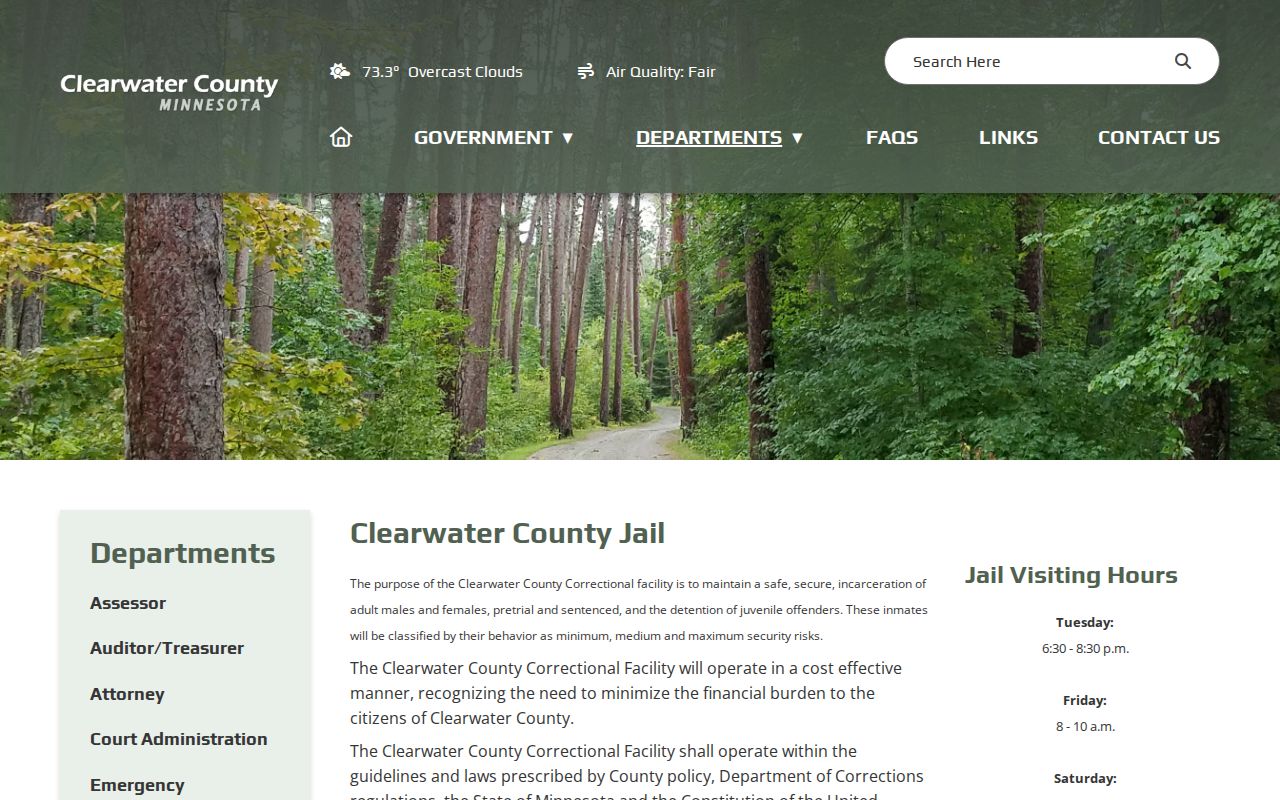
Treat that page as visiting information only. Get warrant and bond answers from Clearwater County's court and sheriff instead.